|
Getting your Trinity Audio player ready...
|

No, blogging isn’t dead—but it is evolving. The businesses cutting back on blogging right now are making a costly mistake, while those adapting their content strategy for AI search are seeing remarkable growth.
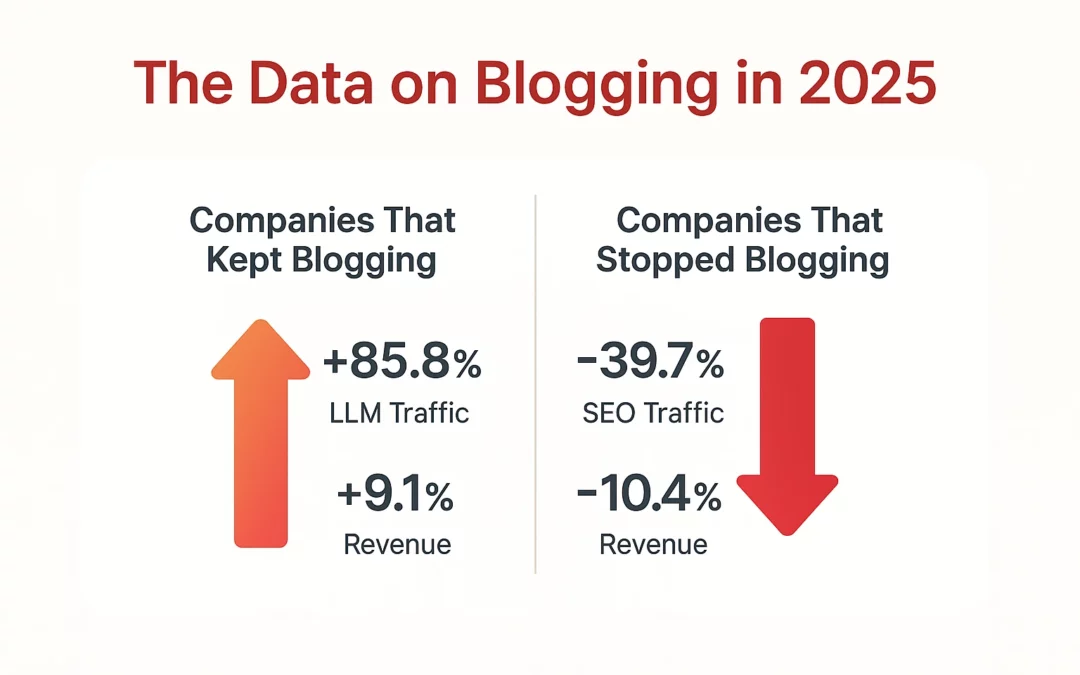
Here’s the proof: recent performance analysis shows companies that kept blogging saw revenue grow by 9.1% and gained 85.8% more LLM traffic. Meanwhile, companies that stopped blogging watched their revenue decline by 10.4% and lost 39.7% of their SEO traffic.
The difference is staggering, and it reveals an important truth. Blogging works. What doesn’t work is treating your blog the same way you did five years ago. Google and AI platforms like ChatGPT, Perplexity, and Gemini rely on fresh, structured, and authoritative content to decide what to show and cite. When you stop publishing—or when you publish without adapting to how AI search works—you stop sending those critical signals.
If your blog hasn’t been delivering the results you want, don’t scrap it. Restructure it.
The Hard Data: What Happens When You Stop Blogging
Let’s start with the numbers, because they tell a compelling story about what’s really happening in the content marketing landscape.
Companies That Kept Blogging: The Results
Over a 12-month period, businesses that maintained consistent blogging saw:
- SEO traffic drop of 18.2% – Yes, traditional search traffic declined, but far less than those who stopped
- LLM traffic increase of 85.8% – Massive growth in citations and mentions across AI platforms
- Revenue growth of 9.1% – Positive ROI despite changes in the search landscape
These companies adapted. They kept producing content but restructured it for the AI era.
Companies That Stopped Blogging: The Consequences
The businesses that paused or eliminated their blogging efforts faced harsh reality:
- SEO traffic drop of 39.7% – More than double the decline of companies that kept blogging
- LLM traffic increase of only 6.5% – Minimal growth in AI platform visibility
- Revenue decline of 10.4% – Negative growth directly tied to reduced content investment
Why the Difference Is So Dramatic
The answer lies in how modern search works. AI systems don’t just rank pages—they actively look for fresh, authoritative content to cite in their answers. Analysis of 150,000 LLM citations shows that platforms like ChatGPT and Perplexity heavily rely on structured, authoritative content, with Reddit leading at 40.1% citation frequency and Wikipedia at 26.3% Visual Capitalist.
When you stop publishing, you signal to both traditional search engines and AI platforms that your site isn’t active, current, or authoritative. That matters more now than ever before.

Why Is Blogging Still Relevant in 2025?
Let’s address the skepticism head-on with hard statistics.
The Numbers Don’t Lie: Blogging Statistics That Matter
Industry research shows that businesses with blogs enjoy 434% more indexed pages, experience a 55% increase in website traffic, and B2B companies see 67% more leads DemandSage. Even more compelling? Marketers who prioritize blogging are 13 times more likely to achieve positive ROI than those who don’t DemandSage.
The blogging ecosystem is massive and growing:
- There are over 600 million blogs worldwide, with 7.5 million posts published daily Wix
- 83% of internet users—approximately 4.44 billion people—read blogs regularly OptinMonster
- 70% of consumers prefer learning about companies through blog articles rather than ads, and 74% of B2B buyers conduct more than half of their business research online Wix
These aren’t numbers from a dying channel. They’re numbers from a thriving, evolving one.
How AI Search Platforms Rely on Fresh, Structured Content
According to Semrush’s 2025 AI Overviews study, Google’s AI Overviews now appear in 88% of informational search intent queries, with growing use in commercial and navigational queries Semrush. This means AI-generated summaries are becoming the default way people consume information.
Here’s what’s critical to understand: only 12% of ChatGPT citations match URLs on Google’s first page Semrush. Success in traditional SEO doesn’t automatically guarantee visibility in AI search results. AI platforms evaluate content based on clarity, structure, trustworthiness, and topical relevance—not just keyword rankings.
Data from 400+ websites shows that AI-referred sessions jumped from 17,076 to 107,100 between January and May 2025—a massive 527% increase in just five months Superprompt. Some SaaS sites now see over 1% of all sessions coming from large language models.
This isn’t a future trend. It’s happening right now.
The Real Problem Isn’t Blogging—It’s Outdated Blog Strategies
The blogs that struggle aren’t failing because blogging is dead. They’re failing because they’re using 2019 strategies in 2025.
According to the annual blogger survey, the average blog post now takes just under 3.5 hours to write, down from previous years, largely due to AI assistance Orbit Media Studios. But here’s the catch: 95% of marketers now use AI in their workflows Orbit Media Studios, and many are publishing generic, unverified content that AI platforms won’t cite.
We’ve seen this firsthand with our clients. By simply optimizing metadata, images, and ensuring quality content that’s more likely to be cited by AI, one client saw 100% traffic increase in just three months. The fundamentals still work—they just need to be applied with AI search in mind.
For a deeper understanding of what makes content truly valuable, explore our guide on E-E-A-T content quality principles.

How AI Search Has Changed the Blogging Game
Understanding the shift from traditional SEO to AI-optimized content is essential for blog success in 2025.
From Keyword Rankings to AI Citations
Traditional SEO focused on ranking your page #1 for target keywords. AI search focuses on whether your content gets cited when someone asks a question.
The distinction matters. When someone searches “best CRM for startups” on Google, they see a list of ranked results. When they ask ChatGPT or Perplexity the same question, they get one synthesized answer that cites 3-5 sources. If you’re not one of those sources, you’re invisible.
Reddit leads citation frequency at 40.1%, followed by Wikipedia at 26.3% Visual Capitalist—not because they have the best SEO, but because they have structured, community-validated content that AI systems trust.
What LLMs Look for When Selecting Content to Cite
Analysis of millions of AI citations reveals the exact factors that determine citations: structured heading hierarchy increases citation likelihood by 40%, fresh content updated within 30 days gets 3.2 times more AI citations, sites with 50+ referring domains see 5 times more AI traffic, and pages with original data get 4.1 times more citations Superprompt.
Notice what’s on that list: structure, freshness, authority, and original data. These aren’t radical new concepts—they’re SEO fundamentals evolved for AI systems.
The New Currency: Visibility Over Clicks
Here’s something that might surprise you: AI referral traffic matters less than you think. Research shows that LLM traffic grew 65% year-to-date but should be assumed at zero for planning purposes, because LLMs make clicks redundant Growth-memo.
When ChatGPT cites your brand in an answer, the user might never click through to your site. But they’ve now been exposed to your brand, learned about your expertise, and may search for you directly later. The currency of AI search isn’t clicks—it’s visibility, trust, and brand awareness.
This requires rethinking how you measure blog success. Instead of obsessing over traffic numbers, track brand mentions, citation frequency, and direct search growth.

How Do I Restructure My Blog for AI Search Success?
Let’s get practical. Here’s how to audit and update your existing blog content for the AI era.
Audit Your Existing Content for AI Readiness
Start by reviewing your top 20 blog posts by traffic. Ask yourself:
- Does each post have a clear heading hierarchy (H2, H3 structure)?
- Do you answer the main question in the first 2-3 sentences?
- Have you updated the content in the past 12 months?
- Do you include specific data, statistics, or expert quotes?
- Is structured data (schema markup) implemented?
Recent SEO audit analysis shows that audit clients saw an average increase of 47% in Google traffic within a few months of implementing clarity-focused recommendations Search Engine Land. The low-hanging fruit is often simpler than you think.
Update with Structure, Clarity, and Fresh Data
Sites with structured heading hierarchies (H2→H3→bullet points) are 40% more likely to be cited by AI Superprompt. This isn’t about gaming the system—it’s about making your content easy to parse and understand.
Break up long walls of text into digestible sections. Use descriptive headings that could work as standalone questions. Add current statistics from 2025, not 2022. Replace vague claims (“our solution is innovative”) with specific data (“our clients see an average 67% increase in qualified leads”).
Most importantly, start each section with a direct answer. If someone asks “how long does SEO take,” don’t make them read five paragraphs before getting to “typically 4-6 months for meaningful results.” Lead with the answer, then provide context.
Implement Schema Markup and Structured Data
Schema markup is the language AI systems speak. It explicitly tells crawlers “this is an article,” “this is a FAQ,” “this is a how-to guide,” or “this is a product review.”
Pages with proper structured data are significantly more likely to be cited Superprompt. At minimum, implement:
- Article schema for blog posts
- FAQ schema for question-and-answer sections
- HowTo schema for step-by-step guides
- Organization schema for author credibility
If this sounds technical, don’t worry. Most modern content management systems have plugins or built-in tools that make implementation straightforward.
Create “Answer-Ready” Content That AI Can Quote
Think in terms of quotable statements. Each paragraph should contain at least one sentence that could stand alone as a complete answer.
Bad example: “There are many factors that influence this complex process, and understanding them requires careful consideration of multiple variables.”
Good example: “Content freshness increases AI citations by 3.2 times compared to outdated articles.”
The second example gives AI something concrete to cite. The first is filler that provides no quotable value.

The Five Essential Elements of AI-Optimized Blog Content
Let’s break down what makes blog content work in 2025.
Clear Heading Hierarchies That Guide AI Parsing
Your H2 and H3 tags aren’t just for visual organization—they’re structural signals that help AI understand your content hierarchy. Each heading should:
- Clearly indicate what the following section covers
- Work as a standalone question when possible
- Follow logical progression (don’t jump from H2 to H4)
- Include your target keywords naturally
Think of headings as a table of contents that both humans and AI can follow instantly.
Direct Answers Positioned at the Top
We can’t emphasize this enough: answer the question immediately. LLMs scan content quickly to extract clean, concise answers—start blog posts with a clear summary or TL;DR, use answer boxes with one to two sentences summarizing concepts, and provide clear definitions and actionable steps Writesonic.
Every major section should follow this pattern: answer first, explanation second, examples third.
Statistics, Expert Quotes, and Original Data
Pages with original data get 4.1 times more citations than those without Superprompt. If you can publish original research, surveys, or case study data, you’ve dramatically increased your citation potential.
Can’t conduct original research? Quote credible experts, cite authoritative studies, and reference specific statistics with sources. Generic statements like “many businesses struggle with this” do nothing. Specific claims like “74% of B2B buyers conduct over half their research online” give AI something concrete to work with.
Regular Content Updates and “Last Modified” Dates
Content updated within 30 days gets 3.2 times more AI citations Superprompt. Set calendar reminders to review and refresh your top-performing content every 6-12 months.
Small updates matter. Swap out a 2023 statistic for 2025 data. Add a new example. Update product pricing or feature references. Include a “Last updated” date prominently on your posts—it signals freshness to both readers and AI crawlers.
Internal Linking That Demonstrates Topical Authority
Strategic internal linking shows AI systems (and readers) that you have depth of coverage on a topic. When you write about content marketing, link to related posts about SEO, email campaigns, and social media.
This isn’t about keyword stuffing anchor text. It’s about creating a web of interconnected expertise that establishes you as an authority. For broader website strategy, check out our holistic approach to website marketing.
What Mistakes Should I Avoid When Updating My Blog Strategy?
Even well-intentioned content updates can backfire if you make these common mistakes.
Don’t Abandon SEO Fundamentals
AI search optimization isn’t a replacement for traditional SEO—it’s an evolution. Research shows that continuing with a strong traditional SEO strategy gets you 77% of the way to AI visibility, with sites ranking in Google’s top 10 significantly more likely to be cited by AI models Superprompt.
Keep doing keyword research. Build quality backlinks. Optimize page speed. Ensure mobile responsiveness. These fundamentals create the foundation that AI optimization builds upon. For a refresher on core practices, review our guide to comprehensive SEO fundamentals.
Don’t Let AI Generate Everything Without Human Oversight
The time spent on each blog post has come down in recent years, possibly because 95% of marketers now use AI in their workflows Orbit Media Studios. AI is a powerful tool for outlines, research, and drafts—but publishing unedited AI content is a recipe for disaster.
AI hallucinates facts, produces generic language, and lacks the authentic expertise that builds trust. Use AI to accelerate your process, but always add human insight, verify facts, and inject your unique perspective.
Don’t Ignore Content Freshness
Stale content sends negative signals to both traditional search engines and AI platforms. If your last blog post is from 2022, you’re telling the world (and AI) that you’re not actively engaged in your space.
You don’t need to publish daily. But you do need consistency. Whether that’s weekly, bi-weekly, or monthly, maintain a regular publishing cadence and update old content systematically.
Don’t Treat AI Optimization as Separate from Traditional SEO
The biggest mistake we see is companies creating separate “AI content” and “SEO content” workflows. This duplicates effort and creates inconsistency.
Clarity beats everything—the blogs winning today aren’t simply well-written or packed with keywords, they’re clean, consistent, and instantly understandable to both readers and machines Search Engine Land. Good content works across all channels.
How to Measure Success in the AI Era
Traditional metrics like rankings and traffic tell part of the story. Here’s what else you should track.
Track LLM Citations and Brand Mentions
Use tools that track when AI platforms mention or cite your brand across ChatGPT, Perplexity, Claude, and Gemini Ahrefs. Create a list of 10-20 questions your content should answer, test them monthly across different AI platforms, and document which sources get cited.
Share of voice in AI answers is becoming as important as keyword rankings once were.
Monitor AI Referral Traffic Growth
Set up tracking in Google Analytics to identify traffic originating from AI platforms. While LLM referral traffic should be planned at zero due to its unpredictability Growth-memo, monitoring the trend helps you understand impact.
More importantly, watch for increases in direct traffic and branded search volume—these often indicate that AI mentions are driving brand awareness.
Measure Revenue Impact, Not Just Traffic
This is where the data at the beginning of this article matters most. The companies that kept blogging saw 9.1% revenue growth. Those that stopped saw 10.4% revenue decline.
Connect your blog metrics to business outcomes. Track lead generation, demo requests, email signups, and sales conversations that mention they found you through content. This complete picture justifies continued content investment.
If you need help developing measurement frameworks that connect content to revenue, explore our SEO and content strategy services.
Your Blog’s Future Starts Now
The evidence is clear. Blogging isn’t dead—companies that maintain consistent, high-quality blogging see revenue growth and dramatic increases in AI platform visibility. Meanwhile, businesses cutting their blog budgets are watching traffic and revenue decline.
The difference between these outcomes isn’t mysterious. It’s about evolution, not elimination. The blogs that succeed in 2025 are the ones that:
- Maintain regular publishing schedules with fresh, original content
- Structure content for both human readers and AI parsing
- Lead with clear, direct answers that AI systems can cite
- Update existing content systematically rather than just publishing new posts
- Measure success through visibility and revenue, not just traffic
Your blog isn’t failing because blogging doesn’t work. It’s underperforming because it’s applying yesterday’s strategies to today’s search landscape.
Ready to restructure your blog strategy for the AI search era? Partner with Come Alive to audit your existing content, develop an AI-optimized publishing plan, and future-proof your content investment. We can’t wait to help you turn your blog into the revenue-generating asset it should be.