|
Getting your Trinity Audio player ready...
|
Quick Summary:
- Google’s AI Mode now handles over a billion searches a month, and it’s changed how people look for businesses online.
- Searches are longer, more conversational, and increasingly done by voice or photo.
- Google’s AI decides what to cite based on trust, clarity, and how fresh your content is, not just keywords.
- Only a small slice of AI Mode sessions click through to a website, but the visitors who do are far more informed and ready to buy.
- The takeaway: clear, well-structured, regularly updated content matters more than ever if you want Google’s AI to notice (and recommend) your business.
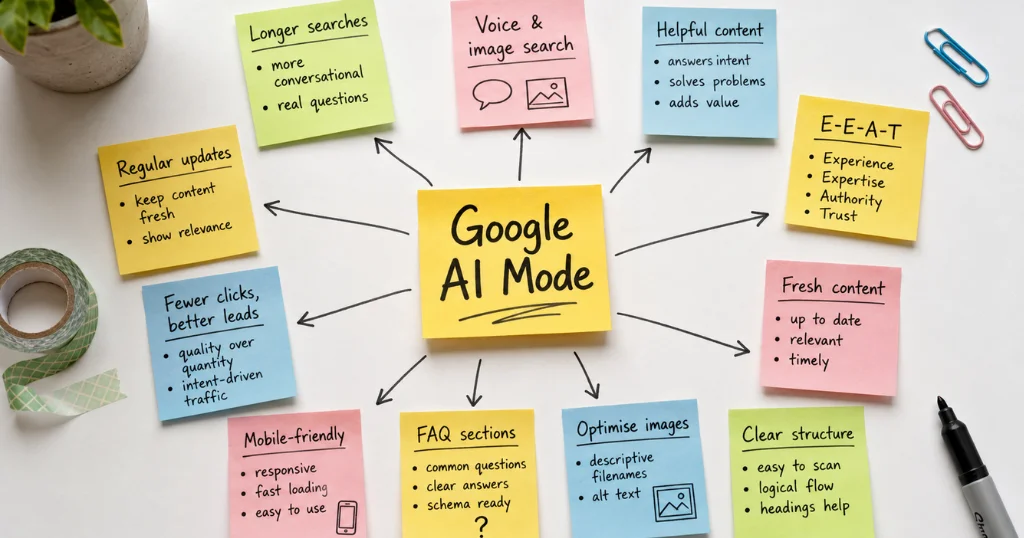
The way people search Google has changed more in the last year than in the previous decade, and most business owners haven’t noticed yet.
In May 2025, Google launched something called AI Mode. Within a year, it had over one billion monthly active users globally. Queries have more than doubled every single quarter since launch. And the way people are typing (or talking, or photographing) their searches looks almost nothing like it did before.
If your business has a website, and you care about people finding you on Google, this matters to you. A lot.
But don’t worry. You don’t need to be a tech expert to understand what’s happening or what to do about it. This post breaks it all down in plain English, with practical steps you can start thinking about today.
What Exactly Is Google AI Mode?
The Old Way vs. the New Way
Think about how you used to search Google. If you wanted to find a store that sold a specific type of product, you’d type something short and clunky like: “winter jackets Cape Town” or “birthday cake delivery Johannesburg.”
That’s because search engines used to work best with short keywords. You had to translate your actual question into a format the machine could understand.
Google AI Mode changes all of that. Now, people can type (or say) exactly what they mean, in plain, natural language, the way they’d ask a real person. The AI, powered by Google’s Gemini model, understands the full question and gives a direct, conversational answer, pulling information from across the web.
What Does a Google AI Mode Result Look Like?
Let’s use a practical example. Say someone is shopping at Checkers and they spot a product they want to buy online but can’t find in-store. Instead of typing “red cast iron pot buy online,” they can now take a photo of the product with their phone and ask Google: “Where can I buy this online in South Africa, and is it cheaper anywhere?”
Google AI Mode will look at the photo, understand what it is, search multiple sources at once, and give a direct answer complete with links to where it found the information.
That’s a big shift. And it’s already happening at scale.
How Are People Searching Differently Now?
Queries Are Getting Much Longer and More Conversational
One of the most striking findings from Google’s own AI Mode research is this: the average AI Mode search query is three times longer than a traditional search query.
People aren’t typing “gym shoes sale.” They’re typing things like: “I need comfortable running shoes for someone with flat feet, a budget of around R800, and I want to buy them this weekend in Pretoria.”
That’s a full sentence. It’s a conversation. And it means the content on your website needs to be able to answer those kinds of real, specific questions not just match a keyword or two.
Searches Are Going Multimodal: Voice, Image, Video
It’s not just text anymore. More than one in six AI Mode searches are now multimodal, meaning people are searching using their voice, a photo they’ve taken, a video, or even a live camera feed.
Image-based searches in particular are growing by over 40% month-on-month. That means your product photos, images on your website, and visual content are no longer just decoration, they’re increasingly part of how people find you.
People Are Asking Follow-Up Questions, Not Just One Search
AI Mode is also conversational in a back-and-forth sense. Someone might search for “best braai wood in Durban” and then immediately follow up with “how long does it burn for?” and then “where can I buy it near me?” all within the same search session.
Follow-up queries in AI Mode have grown by more than 40% per month in the US alone. The top keywords people are using in AI Mode searches? Find, Identify, Explain, Summarise. People want depth, not just a list of links.
What Does Google AI Mode Mean for Your Business Website?
Will Fewer People Click Through to My Website?
This is the big question, and it’s worth being upfront about. Yes, for some types of searches, AI Mode answers the question directly on the page, which means the person doesn’t always need to click through to a website to get an answer.
Early data suggests only around 6–8% of AI Mode sessions result in an external click. That sounds alarming. But here’s the important flip side: why strong SEO fundamentals still matter more than ever because when someone does click through, they already know what they want. They’re a more informed, more motivated visitor. The quality of the traffic is going up, even if some of the volume changes.
And for local businesses, service providers, and e-commerce stores? People still need to actually visit your store, book your service, or buy your product. AI Mode doesn’t do that for them.
Does My Website Content Still Matter?
Absolutely, in fact, it matters more. Google’s AI Mode pulls its answers from websites. If your content is clear, trustworthy, and answers real questions, there’s a real chance your business gets cited in those AI answers which puts you in front of people even before they click anywhere.
Think of it as being quoted as an expert. You want to be the source Google trusts enough to reference.
How Does Google’s AI Decide Whose Content to Show?
Quality and Trust Signals (E-E-A-T, Explained Simply)
Google uses a framework called E-E-A-T – Experience, Expertise, Authoritativeness, and Trustworthiness, to decide which content is good enough to show in its AI answers.
In practice, that means Google is looking for content that:
- Was clearly written by someone who knows what they’re talking about
- Is factually accurate and backed up by real information
- Comes from a website that is credible and has a track record
- Genuinely helps the person asking the question
Research by Wellows found that 96% of AI Overview citations come from sources with strong E-E-A-T signals. In other words, Google is giving its trust to a relatively small group of websites that have earned it. The good news? Any business can build those signals over time, with the right content strategy.
Clear, Well-Structured Content Wins
Google’s AI doesn’t just look at what you’ve written, it looks at how you’ve written it. Content that uses clear headings, direct answers, and structured formatting is much easier for the AI to extract and cite.
If your website has long, rambling paragraphs with no clear structure, the AI is going to skip over it in favour of something it can read quickly and confidently summarise. Short paragraphs, clear headers, and FAQ-style sections all help.
Fresh Content Gets Cited More Often
Research by Seer Interactive found that 85% of AI Overview citations came from content published in the last two years, with 44% from 2025 alone. That’s a strong signal: if your website content is three or four years old and hasn’t been touched since, it’s losing ground, not because it’s wrong, but because fresher content is competing for the same spot.
Keeping your key pages up to date isn’t just good housekeeping. It’s now a meaningful part of staying visible.
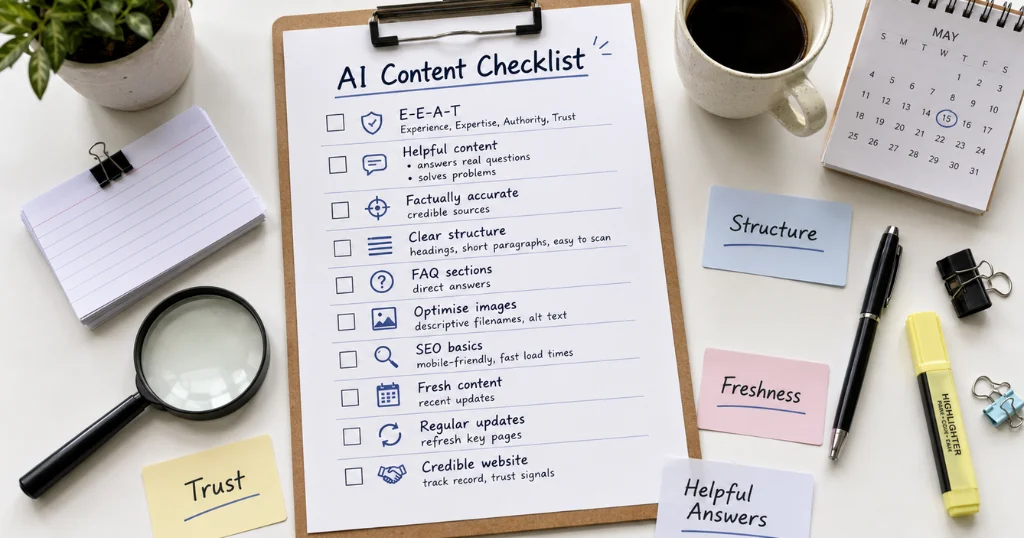
How Do You Get Your Business Featured in Google AI Search Results?
Getting cited in Google AI search results isn’t about tricks or shortcuts, it’s about giving Google content it can confidently trust and share. Here’s what to focus on:
Write content that answers real questions. Think about the actual questions your customers ask before they buy, while they’re comparing options, and after they’ve purchased. Write content that answers those questions clearly and directly. The top first words in AI Mode queries right now are what, how, is, and can, your content should be answering those kinds of questions.
Structure your content for easy reading. Use clear headings for each section. Break information into short paragraphs. Where it makes sense, use bullet points or numbered steps. This makes it easier for both humans and AI to scan and extract your key points.
Make sure the basics of your website are solid. A slow website that doesn’t work well on a phone is going to struggle in AI search. Good SEO basics, fast load times, mobile-friendly design, well-structured pages, are still the foundation that everything else is built on.
Optimise your images. Since image-based searches are growing so fast, make sure your photos have descriptive names and alt text (the short description attached to an image that tells search engines what it shows). A photo of your product labelled “IMG_4521.jpg” tells Google nothing. “red-cast-iron-28cm-pot-south-africa.jpg” tells Google exactly what it is.
Keep your content fresh. Commit to updating your key pages and publishing new blog posts regularly. You don’t need to rewrite everything, but reviewing and refreshing your most important content at least once a year makes a real difference.
One of our clients saw their website traffic double in just three months by focusing on exactly these fundamentals, optimising their metadata, improving their images, and publishing quality content that AI is more likely to cite. No complicated tricks. Just the basics done well.
Your Digital Marketing Future Starts Now
Google AI Mode isn’t a passing trend, it’s the new normal. And the businesses that will thrive in this environment are the ones that treat their website as a living, breathing asset rather than something that gets built once and forgotten.
The great news is that the rules haven’t changed as much as the headlines suggest. Great content, a well-structured website, and a genuine focus on helping your audience, those things have always been what Google rewards. AI Mode just makes them even more important.
If you’re not sure where your website stands, or you’d like a partner to help you navigate the shift, we’d love to chat. At Come Alive, our success relies on yours, and we’re here to help your business stay visible, relevant, and growing in your digital marketing future.
Ready to take the next step? Partner with us on your SEO and Google visibility, and let’s click together.
Frequently Asked Questions
Google AI Mode is a dedicated search experience, sitting alongside tabs like Images and News, that answers your question directly instead of just handing you a list of links. It uses Gemini and a process Google calls “query fan-out” breaking your question into subtopics and running multiple searches at once to build a single, cited answer. Think of it as Google doing several minutes of research for you in a few seconds, then handing you a summary with the sources attached.
No, though the two are closely related. Gemini is Google’s underlying family of AI models, while AI Mode is the search experience built inside Google Search that uses Gemini as its reasoning engine, separate from the standalone Gemini app you might use on its own. For your business, the practical difference doesn’t matter much, what matters is that both are pulling from and citing real websites.
Not for every kind of search. Traditional results and AI Overviews still work best for quick, factual questions, while AI Mode is built for more complex, multi-part questions that benefit from comparison and reasoning. Google has also been merging the two experiences, so people can move from a normal search into an AI Overview and then straight into a follow-up conversation in AI Mode without starting over, which means your content needs to hold up in both worlds, not just one.
Start with your most important pages, the ones about your services, products, or pricing. Put a clear two-to-four sentence answer to that page’s core question right at the top, underneath the heading, in plain language and without fluff. From there, use question-style headings, short answer-first paragraphs, and genuinely specific details (numbers, timeframes, named methods) rather than vague claims, that’s the kind of content AI systems can confidently quote.
Yes. Websites that give clear, direct answers near the top of the page, use question-based headings, and add FAQ schema are more likely to be cited in AI-generated answers, and this now overlaps closely with what good traditional SEO already requires. The trick is making sure each question is phrased the way a real customer would actually ask it, and that the answer is short, direct, and useful on its own.
Not cleanly, no at least not yet. Clicks from AI Mode that do reach your website are generally logged in Google Analytics using the same classification as ordinary Google search, so they usually show up as regular organic traffic rather than a distinct AI Mode source. The best workaround is watching for a rise in impressions without a matching rise in clicks on your informational pages, and keeping an eye on which pages start earning brand mentions, that’s often a sign AI systems are citing you even when you can’t see the click.
It helps enormously. AI systems tend to summarise generic, thin, or keyword-padded content without ever citing it, but when a page contains something genuinely original, proprietary data, a real expert opinion, or specific first-hand experience, the AI usually has to cite the source to use it. For a small business, that could be as simple as sharing real results from your own work, a specific process you follow, or an honest opinion on a common customer question, rather than repeating what everyone else already says.
It’s not instant, but it’s also not a multi-year wait. Industry research on well-structured, freshly published content suggests initial citations can appear within a couple of weeks, with a more noticeable improvement in visibility building up over a few months of consistent publishing. The bigger point is that this isn’t a one-off fix, it rewards businesses that keep their key pages current and keep publishing, rather than those who do it once and move on.