
|
Getting your Trinity Audio player ready...
|
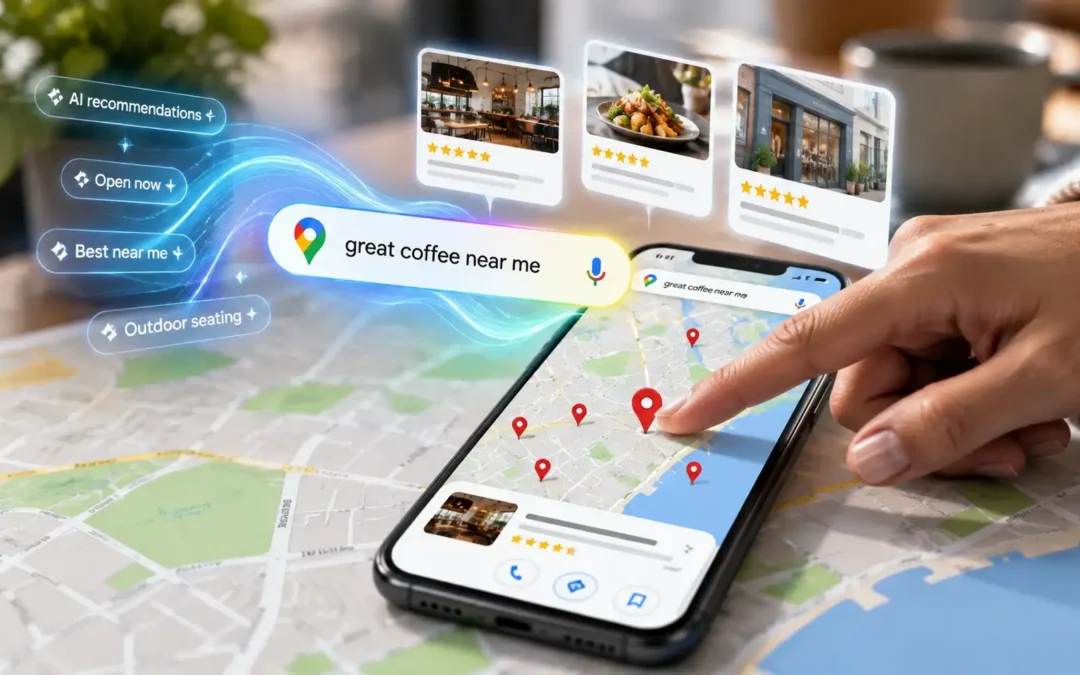
Google Maps is changing how local businesses are discovered – here’s what Ask Maps and AI-driven recommendations mean for your visibility, reviews and Google Business Profile.
Quick Summary
- Google Maps is introducing Ask Maps, a conversational alternative alongside traditional Maps search. In industry testing, responses have commonly surfaced around 3 to 8 businesses, though Google hasn’t confirmed this as a fixed number.
- Google is rolling out two big changes to Maps: Ask Maps can now help with things like building a food order, checking hotel availability and finding ticket links, and a new feature called Tell Maps lets people update business information just by talking or uploading a photo. Together, they mean your Google Business Profile is no longer just a listing for people to scroll past. Google’s AI now reads it, decides whether to trust it, and increasingly helps customers act on it.
- Star ratings alone don’t help you as much as they used to. AI reads the actual words in your reviews, posts and website to decide whether you’re a good match for what someone is searching for.
- Old website pages, broken or forgotten links, and an incomplete Google Business Profile can lead AI to confidently tell a customer something that simply isn’t true about your business.
- Showing up in the traditional “map pack” of three businesses matters less than it used to. Being one of the handful of businesses AI actually recommends is becoming the real measure of success.
If you only take one thing from this post: the businesses that win in 2026 are the ones feeding Google clean, specific, consistent information at every touchpoint. Here’s what that actually looks like.
Local Search Doesn’t Work the Way It Used To
Type “pizza near me” into Google Maps a few years ago, and you’d get a long, scrollable list of results ranked roughly by relevance and distance. You’d scroll, compare star ratings, maybe check a few photos, and make your own call.
That experience is disappearing. Google Maps is shifting from keyword matching to conversational discovery, and instead of handing you 20-plus options, it now curates a short, specific shortlist based on exactly what you asked for, where you are and what it already knows about your preferences.
That shift changes everything about how local businesses need to show up online, and it starts with understanding how AI actually filters who makes the cut.
From “Pizza Near Me” to Curated AI Recommendations
Ask Maps, Google’s new conversational search feature, doesn’t just match keywords anymore. It reads what someone actually means, checks that against everything Google knows about your business, and quietly leaves out anyone who doesn’t fit, before the customer ever sees a list to choose from.
Two things trip businesses up most:
Not matching the vibe of the search, even if you technically qualify. Search for “healthy fast food,” and a big chain like McDonald’s can be left out entirely. Technically it is fast food, but everything Google knows about it (its menu, its category, the words people use in reviews) doesn’t line up with “healthy.” The same thing can happen to any business whose online information doesn’t quite match how people describe it.
Missing details on your profile. A search like “dirty chai latte while I work on my laptop” works best when your Google Business Profile actually confirms you have Wi-Fi and that specific drink on the menu. If that information isn’t listed anywhere Google can find it, you’re less likely to come up for that search, because Google simply has less information confirming you’re a match. This is why filling in every field on your profile (hours, services, amenities, menu items) matters so much more than it used to.
The stakes here are real. There’s no “next page” button in Ask Maps. If you’re not included in that particular response, you may simply miss that customer’s initial consideration set entirely.
It also helps to understand why two people can type the exact same search and get completely different results. Google now blends what someone typed with what it already knows about them, their location, past searches, saved preferences, to build a shortlist made just for that person. Because of this, there’s no longer one single “top spot” you can rank for and be done. That’s exactly why having strong, consistent information across your whole online presence matters more than chasing one ranking position ever did.
The Numbers Behind the Shift
Traditional local ranking factors haven’t gone away. Google’s own guidance still says local results come down to relevance, distance and prominence, including a complete profile, quality reviews and links. What’s changed is that AI has added a new layer on top of that.
The numbers show just how fast this is moving. According to Places Scout’s tracking across 1,200 mobile ranking reports, paid ads in the map listings jumped from under 3% to roughly 22% of searches between November 2025 and January 2026 alone, squeezing out free (organic) visibility. A Sterling Sky/Jepto study of 179 Google Business Profiles across 34 US law firms found direct clicks-to-call declining steadily over two years, a trend worth watching even though it’s one dataset rather than every industry. And a Local Falcon study of 60,000 local-business searches found AI Overviews appearing in 40.2% of them, though that rate varies a lot depending on the type of search.
Here’s the part that should really get your attention: in Google’s own mobile-local research, 76% of people who search for something nearby on their phone visit a business within a day, and 28% of those searches lead to a purchase. It’s older research, not a fresh 2026 number, but it still points to something important: these are high-intent customers, ready to act fast. If AI filters your business out of its recommendations, you’re not just missing a bit of online visibility, you’re missing customers who were about to walk through your door or pick up the phone.
Your Business Profile Is Becoming Something AI Can Act On
This is a real shift for business owners to wrap their heads around: your Google Business Profile isn’t just something people read anymore. Ask Maps can now help customers take action on it directly.
Here’s what that actually looks like: a customer asks Ask Maps to “find a burger and fries spot on my route home, open now.” Ask Maps scans the route, your opening hours and menu data, then builds a food order for the customer to review and complete through supported partners like Square or Toast (with Uber Eats on the way). For hotels, it currently helps compare prices and availability. For events, it surfaces direct ticket links. The customer still reviews and confirms before anything is finalised, but the point stands: AI is now reading your menu, hours and pricing data to build that shortlist in the first place.
In other words, your Google Business Profile and your website need to agree with each other, because AI is now pulling from both to help customers take real action. If your menu, hours or booking details are inconsistent or incomplete, you’re not just missing a listing, you’re missing the sale.
There’s a limit worth knowing about, too. For eligible users in supported countries who opt in, Ask Maps can look at their own Gmail, Calendar and Google Photos to make better suggestions, for example, spotting a flight booking to recommend airport dining, or noticing past bookings to guess someone likes high-end restaurants. It’s clever, but it can also get the wrong end of the stick. AI might recommend a steakhouse based on someone’s last order, not realising that order was actually for their spouse. It sounds confident even when it’s guessed wrong, which is exactly why your own profile needs to be as clear and accurate as possible. The clearer your information, the less room AI has to guess incorrectly.
How Do You Stop AI From Hallucinating About Your Business?
“AI hallucinating” simply means AI confidently states something as fact when it’s actually wrong. It doesn’t know it’s wrong, it just found information somewhere and presented it as true. This matters more than ever now, because Google is using AI both to help process contributions to Maps and to answer customer questions about your business, and both of those come with risks.
With a new feature called Tell Maps, currently rolling out in the US, Google lets its millions of users suggest updates to Maps information just by talking or uploading a photo. Someone can take a photo of your shop’s sign, and Google’s AI will read the hours off it and ask them to confirm the update. Someone can simply say, “more parking is available behind the building,” and that tip gets submitted and, once Google’s systems review it, shown to future visitors. It’s a handy way to keep local information current, and the review step means a suggestion doesn’t just become fact the moment someone types it.
The bigger everyday risk, though, is your own old website content. Ask Maps pulls information from wherever it can find it, including pages on your site you forgot even existed. In one published Ask Maps test, someone asked whether a local jeweller sold Cartier watches. Ask Maps confidently said yes, because it had picked up an old, outdated page on the jeweller’s own website that still had the word “Cartier” in its web address, left over from years earlier. In reality, they didn’t carry Cartier. This shows exactly the kind of mistake that becomes more likely the more forgotten pages sit on your site.
That’s why keeping your website content accurate and up to date matters so much now, it’s your best defence against AI getting facts about your own business wrong. Removing old pages you no longer need, fixing broken or forgotten links, and generally keeping your website’s back-end in good shape all lower the chances of AI digging up something outdated and treating it as current fact.
This is exactly the kind of basic work that pays off. We recently helped a client double their website traffic within three months by getting the fundamentals right: writing clearer page descriptions that tell people (and Google) exactly what to do next, properly sizing and labelling images, and improving overall content quality so it’s more likely to both rank well and be picked up by AI. None of it was complicated. It just required getting the groundwork right.
What Makes a Review “AI-Ready”?
Star ratings still matter, both to human customers scanning quickly and to Google’s own local ranking system. But review text gives AI something a star rating can’t: real context about the specific service or experience behind that rating. And most reviews businesses collect today give AI almost nothing to work with there.
Take a typical 2025-style review: “5 stars! Great plumber, highly recommend. Friendly staff.” To a person, that reads fine. To Ask Maps, it’s close to useless, there’s no specific service, no context, no detail it can match against a future search.
Now compare that to something like: “5 stars! My water heater broke on a Sunday, got same-day emergency service, transparent pricing, and the technician left the basement spotless.” That review feeds directly into future AI prompts like “weekend emergency plumbing” or “water heater replacement,” because it contains the exact situational detail AI is trying to match.
The practical takeaway is simple: change what you ask for when you solicit reviews. Instead of “leave us a rating,” try “tell us what problem we solved for you and how.” That one shift in phrasing can turn your reviews from decoration into genuinely useful context that AI can draw on when matching businesses to relevant searches.
What Is “Recommendation Readiness”?
If rank tracking is losing relevance, what should you actually be measuring and building towards? Three areas matter, and they work best together rather than as a checklist to tick off one at a time.
Detailed reviews. As covered above, descriptive customer stories beat a plain star rating every time, because they give AI real detail to work with.
Your posts and social media. Google can surface information from your linked social profiles and Google Business Profile posts, including things like events, deals and offers. It hasn’t confirmed exactly how much weight this carries in Ask Maps recommendations, but keeping these accounts accurate and current strengthens the information available about your business either way. Fill in every available field on your profile too: hours, services, accessibility, booking options, all of it.
A clean, accurate website. No old pages hanging around, no outdated service listings, nothing that could let AI dig up something wrong and present it as current fact.
Get all three working together, and you’re no longer chasing a single ranking position. You’re building what Google treats as a trustworthy, joined-up picture of your business, one it can confidently recommend across dozens of different customer situations, not just one search term.
Build Trust With Google, Not Just a Ranking
Traditional local rankings still matter, but they’re no longer the only visibility metric worth paying attention to. The businesses winning in this new landscape aren’t necessarily the ones with the highest star rating, they’re the ones giving Google enough accurate, specific, consistent information to confidently recommend them, again and again, across all kinds of different customer situations.
That means being deliberate about the information you put out there, checking that your website, reviews and social media all tell the same consistent story rather than treating them as separate boxes to tick, and getting comfortable with the idea that AI won’t just read about your business, it may act on your behalf, too.
It’s a genuine shift, and it can feel like a lot to take on alone. That’s where we come in, partner with Come Alive and let’s click together to build your digital marketing future.
Frequently Asked Questions
What is Ask Maps? Ask Maps is Google’s new chat-style search feature inside Maps. Instead of just matching keywords, it understands what someone is actually asking for and returns a short, handpicked list of recommendations based on your Google Business Profile, your reviews, and what it already knows about the person searching.
Do I need to redo my whole Google Business Profile right now? Not necessarily start from scratch, but it’s worth a proper check. Make sure every section is filled in, your hours and menu or service details are correct, and nothing on your website contradicts what’s on your profile.
Does this mean star ratings don’t matter anymore? They still matter to human customers scanning quickly, but AI relies on the actual wording in your reviews. Aim for both, encourage detailed, situational reviews rather than just a star rating.
What’s the single easiest place to start? Go through your website and remove or update any old, forgotten pages first. It’s one of the most controllable sources of outdated information AI might pick up about your business, and it’s entirely within your control to fix.