|
Getting your Trinity Audio player ready...
|
Quick Summary:
- Getting website traffic but no enquiries almost always points to a conversion problem, not a visibility problem
- The most common causes are: the wrong kind of visitors, an unclear value proposition, missing trust signals, weak calls to action, and friction in the contact process
- The average website conversion rate sits between 2% and 5%, so even a “healthy” site converts only a small slice of its visitors
- Adding testimonials and trust signals can lift conversions by up to 34%, making them one of the fastest wins available
- Fixing conversion issues rarely requires a full redesign – most problems can be solved page by page
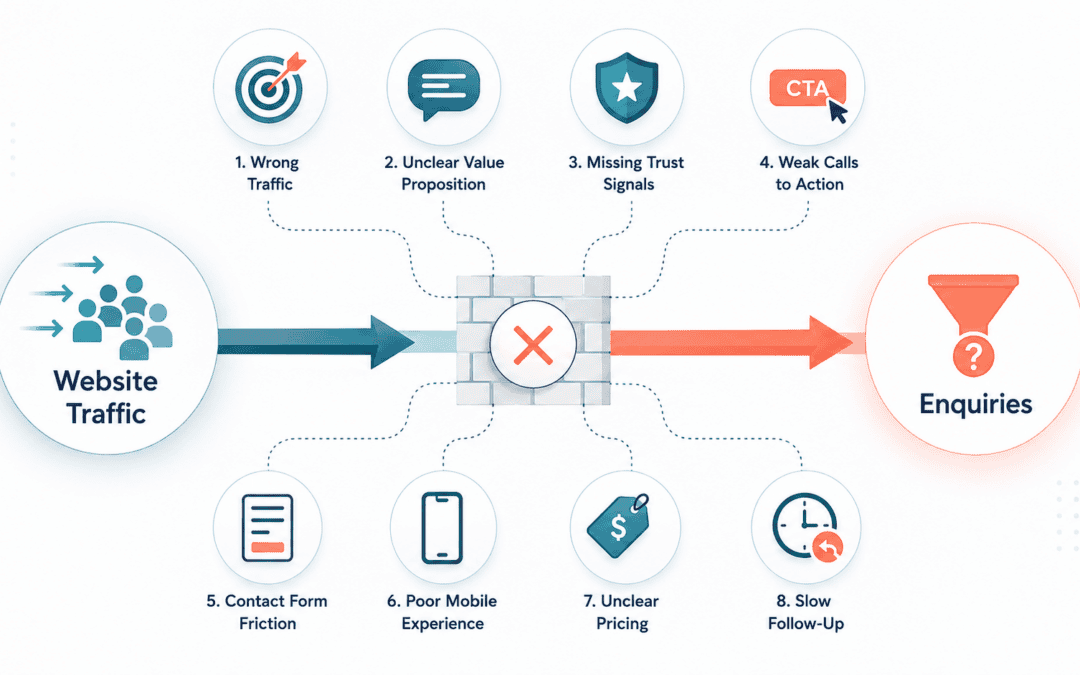
Below, we break down the 8 most common reasons your website gets traffic but no enquiries, and exactly what to do about each one.
You check Google Analytics and the numbers look good. Sessions are climbing, pages are being viewed, people are clearly finding your website. But the phone isn’t ringing and your contact form is empty. It’s one of the most confusing situations in digital marketing, because on paper everything looks like it’s working.
Here’s the key thing to understand: traffic and enquiries are two completely different metrics, and improving one doesn’t automatically improve the other. Getting people to your website is only half the job. Once they land there, your site needs to give them confidence, answer their questions, and make it obvious what to do next. If website traffic but no enquiries sounds like your exact situation, the good news is that this is a conversion problem – and conversion problems are almost always fixable once you know where to look.
1. You’re Attracting the Wrong Kind of Traffic
Not all traffic is created equal. A blog post ranking for “what is digital marketing” brings curious readers. A page ranking for “web design agency Durban” brings people ready to buy. If most of your visitors arrive through broad, informational searches rather than commercial ones, they were never likely to enquire in the first place, no matter how good your website is.
How to fix it: Open your analytics and check which search terms are actually sending you visitors. If most are informational (how, what, why) rather than buyer-intent searches, your content strategy needs to shift toward more specific, SEO-driven service pages that target people closer to making a decision.
2. Your Value Proposition Isn’t Clear Within Seconds
People make decisions about websites remarkably fast. If a visitor can’t immediately understand what you do, who you help, and why you’re the right choice, they’ll leave – not because your service isn’t good, but because your website hasn’t given them a reason to stay.
How Quickly Do Visitors Decide Whether to Trust a Website?
Visitors form trust judgements about a website within about 50 milliseconds, and roughly 94% of that first impression comes down to design. That means your homepage headline and layout need to answer “what do you do” and “who is this for” before a visitor has even consciously registered the question.
How to fix it: Rewrite your homepage headline so it states exactly what you do and who you serve, without vague marketing language. Clear beats clever every time.

3. You’re Missing Trust Signals
Before contacting a business, most people quietly ask themselves whether you’re credible, experienced, and trustworthy. Without visible proof, visitors have little reason to choose you over a competitor – and trust isn’t built through claims, it’s built through evidence.
How to fix it: Add testimonials, case studies, and client logos where visitors can actually see them. Testimonials placed on a homepage can increase conversions by up to 34%, particularly when they mention specific, concrete results rather than vague praise. One Come Alive client, Myartshop.co.za, saw an exponential increase in their traffic within months once they fully optimised their site for both search engines and visitor trust – proof that the fundamentals genuinely move the needle. For a broader look at what a small business site needs to build that trust, see our guide on what a small business website actually needs.
4. Your Calls to Action Are Weak or Missing
A website should guide every visitor toward one clear action – contacting you, booking a call, or requesting a quote. When a site focuses too much on information and not enough on direction, visitors browse, nod along, and leave without doing anything.
How to fix it: Make sure every page has one obvious, specific call to action – not “Learn More,” but something like “Get a Free Quote” or “Book Your Consultation.” Repeat it near the top of the page and again at the bottom.
5. Your Contact Process Has Too Much Friction
Even a genuinely interested visitor can be stopped by small annoyances. A contact form with ten fields, a phone number buried three clicks deep, or no confirmation after submitting all quietly kill enquiries that would otherwise have come through.
How Many Form Fields Should a Contact Form Have?
Three to four fields is the sweet spot for an initial enquiry – typically name, email, and one qualifying question. Simpler forms get more completions, and every extra field you add reduces the chance a visitor finishes it.
How to fix it: Strip your contact form down to the essentials, and add a clear thank-you message or automated reply so visitors know their message actually went through.
6. Your Website Isn’t Mobile-Friendly
If your site is difficult to navigate on a phone – tiny buttons, text that needs zooming, forms that are painful to fill in on a touchscreen – you’re losing a meaningful share of enquiries before visitors even reach your contact page. In 2026, a clunky mobile experience also signals to visitors that a business isn’t quite professional.
How to fix it: Test your own site on your phone, not just your desktop. If anything feels fiddly to tap or read, it’s costing you enquiries. Our team can review your website development setup if you’re not sure where the friction is coming from.
7. Your Pricing Is a Mystery
Visitors often abandon a site simply because they can’t get a sense of cost. You don’t need to publish exact figures, but being open about your pricing range, what affects it, and roughly what to expect builds trust and qualifies visitors before they even contact you.
How to fix it: Add a “starting from” price, a general range, or a clear explanation of what drives your pricing. Vague or entirely absent pricing information creates hesitation, and hesitation kills conversions.
8. Your Enquiries Are Coming In – But You’re Losing Them After the Click
Sometimes the website isn’t the problem at all. If your offer isn’t compelling enough, your follow-up is slow, or enquiries aren’t being responded to consistently, no amount of website traffic will translate into business.
What Is a Good Website Conversion Rate?
A good website conversion rate for most small business websites sits between 2% and 5%, with the global median around 2.35% and top performers converting above 10%. If you’re consistently below 1%, that’s usually a sign of a deeper structural issue – not just bad luck.
How to fix it: Track how quickly your team responds to new enquiries, and audit whether your offer and pricing are genuinely competitive. Sometimes the fix isn’t on the website at all – it’s in what happens in the minutes after someone hits “submit.”

Bringing It All Together
Website traffic but no enquiries is frustrating precisely because it looks like everything is working. But traffic and enquiries measure two different things: one measures visibility, the other measures persuasion. Once you know where visitors are dropping off – the wrong audience, an unclear message, missing trust, friction, or a slow follow-up – each fix is usually specific and manageable.
Ready to turn your existing traffic into real enquiries? Partner with Come Alive and let’s click together to build your digital marketing future.
Frequently Asked Questions
What is a good website conversion rate for a small business?
Most small business websites convert between 2% and 5% of visitors into enquiries, with the global median around 2.35%. Anything above 3.5% is considered strong for most industries.
Why is my website getting traffic but no sales or leads?
It’s usually a combination of two or three issues: the wrong type of traffic, an unclear value proposition, missing trust signals, weak calls to action, or friction in the contact process. Review your highest-traffic pages against these areas first.
Should I redesign my whole website to fix low enquiries?
Rarely, and not immediately. Most conversion problems can be solved page by page – rewriting headlines, improving CTAs, adding testimonials, and fixing form friction. If those changes don’t move the needle, our guide to redesign signs can help you assess whether a bigger overhaul is genuinely needed.
Does adding testimonials really increase conversions?
Yes. Testimonials placed on a homepage can lift conversions by up to 34%, and video testimonials perform even better. Three to five specific, results-focused testimonials tend to work better than a long, generic list.
How can I tell if my traffic has buying intent?
Check which search terms are bringing visitors to your site in Google Search Console or Analytics. Informational searches (“how,” “what,” “why”) signal early-stage curiosity, while specific, service-based searches signal someone closer to making a decision.