|
Getting your Trinity Audio player ready...
|
Quick Summary:
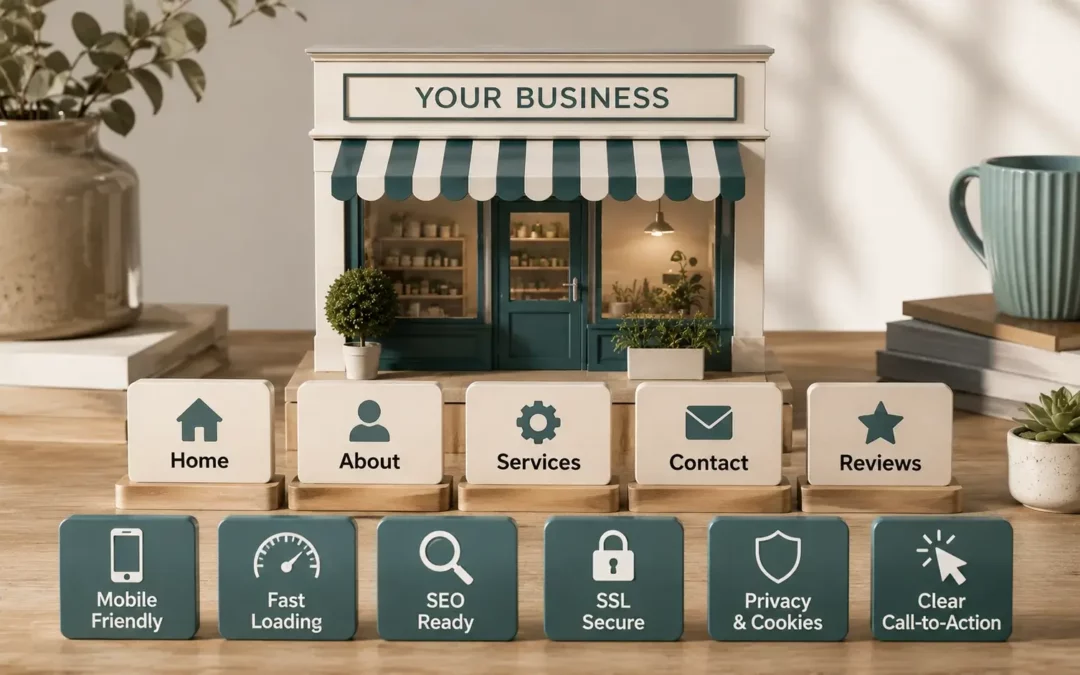
- A small business website needs five core pages: Home, About, Services/Products, Contact, and Testimonials – not twenty
- The homepage carries the most weight, since the majority of visitors never click past it
- Mobile-friendly design, fast load times, and basic SEO are non-negotiable technical foundations in 2026
- South African websites must meet POPIA requirements, including a privacy policy and cookie consent – there is no small-business exemption
- Clear calls to action guide visitors toward contacting you; without them, even a good-looking site won’t convert
Below, we break down exactly what a small business website needs – the essential pages, the technical foundations, and the South Africa-specific compliance requirements many businesses miss.
Building a website for the first time – or rebuilding an old one – can feel overwhelming fast. Should you have ten pages or two? Do you need a blog? What actually matters versus what’s just nice to have? The good news is that a small business website doesn’t need to be complicated. It needs to be clear, purposeful, and built around what visitors are actually looking for when they land on it.
This guide walks through exactly what a small business website needs to work hard for your business – from the essential pages to the technical and legal foundations that are easy to overlook.
The Essential Pages Every Small Business Website Needs
How Many Pages Does a Small Business Website Actually Need?
Most small business websites work well with five to ten core pages – not twenty or thirty. The essentials are Home, About, Services or Products, Contact, and Testimonials. These five pages cover everything a visitor needs to understand your business, trust it, and take action. Three genuinely useful pages consistently outperform fifteen mediocre ones.
Beyond the core five, a Frequently Asked Questions page and a Portfolio or Reviews section are worth adding if they’re relevant to your business, since they build additional trust and handle objections before a visitor even has to ask. What you don’t need is a “Team” page with one person on it, or a lengthy mission statement nobody asked for. Customers want to know what you do and whether they can trust you – keep every page focused on that.
Your Homepage Has to Work the Hardest
The homepage is the single most important page on your website, by a wide margin, because most visitors will only ever see this one page. If it doesn’t answer their key questions immediately, they’ll leave before exploring further.
What your homepage needs to communicate instantly:
- What you do, in plain language – not vague phrases like “innovative solutions for modern challenges”
- Who you do it for
- Where you’re based or who you serve
- How to contact you
If your homepage can’t answer those questions in the first few seconds, everything else on your site becomes harder to sell.
A Clear, Findable Contact Page
Visitors shouldn’t have to hunt for a way to reach you. Your phone number, email address, and physical address (if relevant) should be visible on every page – typically in the header or footer – not buried three clicks deep on a standalone contact page.
How to fix this on your own site:
- Make your phone number tappable on mobile so visitors can call with one touch
- Include a simple contact form with minimal required fields
- Add your business hours and a map link if you have a physical location
- Keep a dedicated Contact page in your main navigation where it can’t be missed
If you’re a local business, this page works even harder alongside your Google Business Profile, which is often where local customers find you before they ever reach your website.
Trust-Building Content: Testimonials, Case Studies & Reviews
A visually appealing website isn’t enough on its own – visitors need reasons to believe you’ll deliver on what you promise. Testimonials, case studies, and genuine customer reviews do the heavy lifting here, turning a good-looking site into a credible one.
Detailed service descriptions that clearly explain the benefit to the customer – not just a feature list – also build this same kind of confidence. If you’re describing what you offer, always translate the feature into what it actually means for the person reading it.
Mobile-Friendly Design Isn’t Optional Anymore
More than half of all website traffic now comes from mobile devices, which means a website that only looks good on desktop is quietly losing customers before they even learn what you offer. A responsive design that adapts cleanly to any screen size isn’t a nice extra – it’s a baseline requirement.
Beyond just looking right, mobile-friendliness also supports better search engine visibility, since Google evaluates most sites based on their mobile experience first.

Site Speed and Basic SEO Foundations
Visitors expect a page to load almost instantly, and even a few extra seconds of load time can noticeably increase bounce rates and reduce enquiries. A fast, well-coded site keeps visitors engaged long enough to actually explore what you offer.
Alongside speed, every small business website needs basic SEO fundamentals built in from the start – clear page titles, sensible URL structures, and content that genuinely answers what your customers are searching for. This isn’t about chasing every keyword; it’s about making sure Google can understand and recommend your site in the first place.
Security: SSL, HTTPS and Visitor Trust
Every small business website needs an SSL certificate, shown as a padlock icon in the browser address bar. It encrypts the connection between your website and your visitors, and without it, modern browsers actively display a “Not Secure” warning that scares potential customers away before they’ve read a word of your content.
This is one of the simplest technical requirements on this list, and one of the most damaging to skip.
POPIA Compliance: A South African Website Requirement, Not a Nice-to-Have
This is where South African websites differ from generic global advice, and it’s a step many small businesses miss entirely.
Does POPIA Apply to Small Business Websites in South Africa?
Yes. The Protection of Personal Information Act applies to every South African business that processes personal information through its website, and there is no small-business exemption. If your site has a contact form, a newsletter sign-up, or even just Google Analytics running in the background, you’re processing personal information and POPIA applies to you.
The core requirements include:
- A compliant, clearly written privacy policy
- A functioning cookie consent mechanism
- A disclosed purpose for any forms that collect personal data
- A registered Information Officer (often the business owner by default)
- A documented process for handling data subject requests
Non-compliance carries real risk – not just fines, but the increasing likelihood that larger clients will ask for proof of compliance before signing a contract with you.

Clear Calls to Action Throughout
Every page on your website should tell visitors what to do next – “Get a Quote,” “Book a Call,” “Contact Us Today.” These calls to action need to be prominent, easy to click, and placed logically throughout the page, not hidden in a footer or buried under paragraphs of text.
A website without clear direction leaves visitors to figure out the next step on their own – and most of them simply won’t bother.
Bringing It All Together
A small business website doesn’t need to be big to be effective – it needs the right pages, built with clarity and purpose, backed by solid technical foundations and, in South Africa, genuine POPIA compliance. Get those fundamentals right, and you’ve built something that actually works for your business, not just something that looks good. If your current site is missing several of these essentials, it might be worth reviewing our guide on the signs it’s time for a redesign – and if you’re starting from scratch, our guide on what a website like this typically costs is a useful next read.
Ready to build a website that has everything it actually needs? Partner with Come Alive and let’s click together to build your digital marketing future.
Frequently Asked Questions
How many pages does a small business website actually need?
Most small business websites work well with five to ten core pages: Home, About, Services or Products, Contact, and Testimonials, expanding only as the business genuinely needs to.
Does a small business really need a blog?
Not always, but it helps. Regularly updated blog content boosts SEO and demonstrates expertise, making it a strong addition once the core essential pages are in place – not a replacement for them.
Is an SSL certificate necessary for a small business website?
Yes. Without SSL, browsers display a “Not Secure” warning to every visitor, which damages trust immediately and can turn potential customers away before they read any content.
Does POPIA apply to small business websites in South Africa?
Yes, without exception. Any website collecting personal information – through a contact form, newsletter sign-up, or analytics tool – must comply, including having a privacy policy, cookie consent, and a registered Information Officer.
What’s the biggest mistake small businesses make with their website?
Focusing too much on design and not enough on structure and clarity. A visually appealing site with confusing navigation or missing essentials still leaves visitors unsure what to do next – and unsure visitors rarely become customers.